Watergy Nexus The Complex Relationship and Looming Crisis Between Our Thirst For Water and Our Hunger for Energy
Powering Farms or Draining Aquifers? Solar Irrigation and the Hidden Costs of Clean Energy February 5th, 2026
Via UPenn’s Kleinman Center for Energy Policy, a report on solar irrigation and hidden costs of clean energy:
In water-scarce farming contexts, solar-based groundwater pumping for irrigation (SGPI) is celebrated for freeing farmers from unreliable diesel and grid power, which enables longer growing seasons and more competitive agricultural production. But this transition does not occur in a vacuum: by eliminating the marginal cost of pumping, SGPI fundamentally alters groundwater extraction incentives and depletes the water tables that farmers depend on.
The spread of solar-based groundwater pumping for irrigation (SGPI) is reshaping the trade and agricultural policy of arid regions. Promoted as a clean, decentralized alternative to diesel- and grid-powered pumping, solar technology promises to democratize energy access and support rural productivity, a possibility driven by rapidly declining photovoltaic costs. Yet beneath this optimism lies a paradox: by lowering the marginal cost of water, solar irrigation encourages intensified groundwater extraction.
Agriculture remains the dominant livelihood across arid and semi-arid regions like India and Sub-Saharan Africa, but productivity is constrained by erratic rainfall and costly, unreliable diesel and grid power. In Rajasthan, where agriculture contributes nearly 30% of gross value added and two-thirds of cultivated land is rainfed, solar energy is ideally suited to a landscape rich in sunshine but poor in water and infrastructure. Solar irrigation may therefore be framed as a “win-win” for rural poverty reduction, energy access, and the clean energy transition.
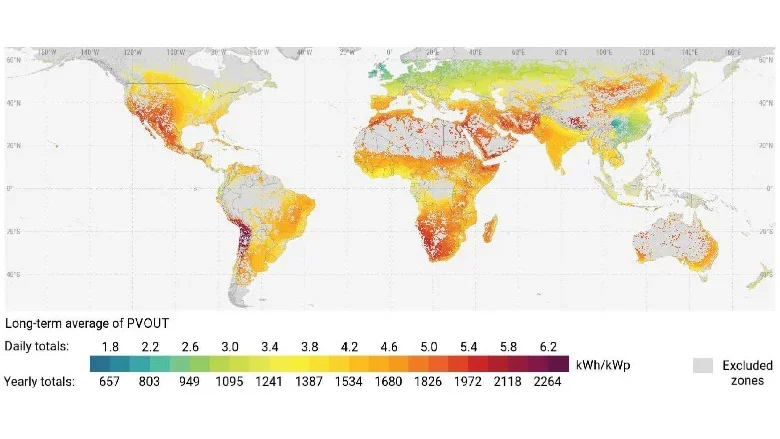
Figure 1: Solar Potential Graph. Regional solar energy potential “after excluding for physical, environmental and other factors” around the world. World Bank Group, 2020. Source.
India’s PM-KUSUM program is an example of an SGPI model. Offering capital subsidiescovering up to 90% of initial costs, India has helped irrigate more than one million acres by supplying subsidized pumps to 100,000 farmers. By 2026, the government aims to install two million new pumps and convert another 1.5 million existing pumps to solar. A similar expansion is underway in Sub-Saharan Africa. Reduced import taxes and private-sector distribution have created a welcoming policy environment, with the potential for eleven million pumps to be installed. That is enough to meet one-third of unmet irrigation needs for smallholder farmers.
The economic benefits of SGPI are significant. In Rajasthan, farmers who adopted solar pumps were able to increase cropping intensity by 2–10%, simultaneously expanding their cultivation of higher-value, water-intensive crops by 10–116%. This led to significant improvements in both food security and farmers’ profits, particularly for those without grid access. By enabling irrigation throughout the day with zero operational costs, solar pumps effectively decouple water access from rainfall and energy scarcity, allowing farmers to produce more consistently and competitively. At the global level, comparative advantage is shifted as marginal regions are integrated into export markets for water-intensive crops.
Yet reduced pumping costs and weak regulation fuel over-extraction; Rajasthan farmers benefiting from solar pumps increased their water withdrawals by 16–39%, threatening already-stressed local aquifers. In some areas of Rajasthan, pumps have been abandoned after groundwater fell below their 400-foot reach. Similar patterns appear elsewhere. In Yemen, where solar irrigation initially sustained agriculture, collapsing aquifers have forced some farmers to pump from depths of more than 1,300 feet. In Sub-Saharan Africa, declining shallow aquifers could leave over 250 million people without water and degrade ecosystems central to fisheries andlivestock. In Rajasthan, falling water tables disproportionately harm “poor and marginalized farmers.” Unable to afford more powerful pumps, such farmers are effectively pushed out.
Policy has begun to respond to over-extraction, though in different ways. In Jordan andMorocco, concerns over over-exploitation and groundwater depletion have led to paused subsidies and low SGPI promotion, respectively. In Rajasthan, however, externalities arebeginning to be internalized. Component C of PM-KUSUM favors grid-connected deployment over off-grid, treating participating farmers as “prosumers” able to sell their surplus electricity back to the grid. By introducing feed-in tariffs, an opportunity cost is effectively restored to pumping: every unit of electricity used for irrigation is a unit foregone in revenue from the grid. This policy is complemented by innovations such as proposed drought-period pricing premiums, feeder-level governance through farmer enterprises, and a shift from recurring power subsidies to one-time capital support. Together, these measures further align farm incomes and fiscal sustainability with aquifer protection.
This entry was posted on Thursday, February 5th, 2026 at 9:24 pm and is filed under Uncategorized. You can follow any responses to this entry through the RSS 2.0 feed.
Both comments and pings are currently closed.
As the scarcity of water and energy continues to grow, the linkage between these two critical resources will become more defined and even more acute in the months ahead. This blog is committed to analyzing and referencing articles, reports, and interviews that can help unlock the nascent, complex and expanding linkages between water and energy -- The Watergy Nexus -- and will endeavor to provide a central clearinghouse for insightful articles and comments for all to consider.
Educated at Yale University (Bachelor of Arts - History) and Harvard (Master in Public Policy - International Development), Monty Simus has held a lifelong interest in environmental and conservation issues, primarily as they relate to freshwater scarcity, renewable energy, and national park policy. Working from a water-scarce base in Las Vegas with his wife and son, he is the founder of Water Politics, an organization dedicated to the identification and analysis of geopolitical water issues arising from the world’s growing and vast water deficits, and is also a co-founder of SmartMarkets, an eco-preneurial venture that applies web 2.0 technology and online social networking innovations to motivate energy & water conservation. He previously worked for an independent power producer in Central Asia; co-authored an article appearing in the Summer 2010 issue of the Tulane Environmental Law Journal, titled: “The Water Ethic: The Inexorable Birth Of A Certain Alienable Right”; and authored an article appearing in the inaugural issue of Johns Hopkins University's Global Water Magazine in July 2010 titled: “H2Own: The Water Ethic and an Equitable Market for the Exchange of Individual Water Efficiency Credits.”